Showing posts with label tsetse fly. Show all posts

Tuesday, November 29, 2016

African sleeping sickness

African trypanosomiasis or "sleeping sickness" is a disease caused by flagellated protozoans that live in blood and in the extracellular tissue fluid.

Human African trypanosomiasis is transmitted only in sub-Saharan Arica, where there are suitable habitats for the tsetse fly vector.

The 31 species and subspecies of Glossina have a wide range of environmental requirements, resulting in discontinuous distribution of the vector across the African tsetse belt.

During 1902 to 2012, 244 cases of African trypanosomiasis were reported in non-endemic countries – most before 1920 and after 2000. 74.3% in the pre-colonial era involved expatriates, missionaries and soldiers; and 78% were due to Trypanosoma brucei gambiense.
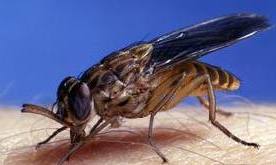
There are two forms of African trypanosomiasis: one, known as gambiense African trypanosomiasis, is endemic in West and Central Africa and causes over 95% of current cases,; the other, known as rhodesiense African trypanosomiasis, is endemic in East and southern African and accounts for the remainder of cases.

Gambiense African trypanosomiasis tends to be transmitted in forested areas along rivers and Rhodesiense African trypanosomiasis is transmitted is separated areas of woodland and savanna.

If left untreated, African trypanosomiasis causes biological damage and leads inexorably to death. If treated late, it can leave major irreversible sequelae: and since patients must stay in bed or in hospital for a long time, they are unable to work.
African sleeping sickness

Friday, June 12, 2015

African trypanosomiasis (sleeping sickness)

African trypanosomiasis or sleeping sickness is a parasitic disease caused by infection with one of two subspecies of Trypanosoma brucei gambiense or Trypanosoma brucei rhodesiense. These parasites are transmitted to humans by the bite of various species of Glossina (tsetse fly).

This fly is the only known vector, so the disease is localized to areas where the fly is able to thrive. The disease is found only in sub-Saharan Africa between latitudes 14 °N and 29 °S within limits of the geographical distribution of the tsetse fly.

The clinical presentation in Trypanosoma brucei rhodesiense is more accurate, however, with overt clinical signs and symptoms developing with days following infection; the Trypanosoma brucei gambiense form is chronic, with months and sometimes years elapsing before the appearance of any obvious signs or symptoms.

Upon infections with Trypanosoma brucei rhodesiense, early symptoms involve fever, swelling of the lymph nodes, headaches, weakness, weight loss and often a rash near the site of inoculation.

African trypanosomiasis is rarely reported outside the continent of Africa where it is endemic. However, world travelers, especially those who go on safari in East Africa, may be bitten by the tsetse fly and develop symptoms after they return to their home countries.
African trypanosomiasis (sleeping sickness)

The Most Popular Articles

CDC Outbreaks - Affecting International Travelers

Other selected articles